
I recently sat down with a client I’ll call Sandra.
Sandra is 58 years old. She earns $130,000 a year as a vice-principal in Mississauga and has saved consistently her whole career. She bought a rental property at the right time, plans to retire at 63.
On paper, Sandra looks like she has done everything right.
But when we ran her numbers, we found four tax problems she had never thought about.
And if she doesn’t deal with them before she retires, she will hand over far more to the CRA than she needs to.
Let me introduce you to Sandra. Then I’ll show you exactly what she’s up against.
Meet Sandra
Sandra is a composite client. She is not one specific person. She represents dozens of Canadians I work with every year. If her story sounds familiar, that’s probably because it is.
She is 58, earns $130,000 a year as a vice-principal, and plans to retire at 63. She has $420,000 in her RRSP. Her husband David is 61, works part time, and earns about $28,000 a year. Together they have $540,000 in registered accounts. Sandra owns a rental property in Hamilton worth $550,000 that she bought years ago for $240,000. She has a TFSA and some non-registered savings. No life insurance. And a will that hasn’t been updated since 2004.
That’s the picture. Now let’s talk about what it actually means.
How Much Do You Actually Need in Retirement?
Before we get to Sandra’s problems, let me anchor on a number most Canadians have never seen.
According to Statistics Canada, the average Canadian senior couple lived on $74,200 after tax in 2022. Adjusted for inflation to today, that’s approximately $82,000 per year.
That’s what the average retired Canadian couple actually spends. Not $100,000. Not $150,000. $82,000.
Sandra thinks she needs $100,000 a year after tax to retire comfortably. That’s not unreasonable for her lifestyle. But here’s the question nobody asked her.
Do you have enough spendable money in the right years?
Retirement isn’t flat. It has three very different spending phases.
| Phase | Years | Annual Spending Target |
| Go-go years | Age 63 to 75 | $90,000 after tax |
| Slow-go years | Age 75 to 85 | $84,000 after tax |
| No-go years | Age 85 onward | $72,000 after tax |
The go-go years are the expensive ones. Travel, hobbies, an active life. Most people over-save for the slow years and under-plan for the early ones.
The question isn’t whether Sandra has enough money overall. It’s whether she has enough after-tax cash in the right phase without paying more tax than necessary to get there.
Retirement Income Doesn’t Come From One Place Anymore
When Sandra was working, her financial life was simple. One employer. One paycheque. Taxes handled automatically.
Retirement is completely different. Income comes from multiple sources at different times with different tax treatment. Managing them well is the difference between a comfortable retirement and an expensive one.
Here are the income buckets Sandra will be drawing from:
Canada Pension Plan (CPP)
CPP is a government benefit based on Sandra’s lifetime contributions. She can start as early as 60 or as late as 70. Every month she delays past age 65 permanently increases her monthly benefit by 0.7%. Waiting from 65 to 70 gives her 42% more for the rest of her life.
Old Age Security (OAS)
OAS is available to most Canadians at 65. She can defer it to 70 for a 36% increase. One important watch — if Sandra’s net income exceeds roughly $90,000 in any year, OAS starts getting clawed back by the CRA.
RRSP and RRIF
Sandra’s RRSP must convert to a RRIF by age 71. A RRIF is a Registered Retirement Income Fund. Once converted, she must withdraw a minimum amount every single year whether she needs it or not. Every dollar withdrawn gets added to her taxable income. The timing of when she starts drawing and how much she takes each year has a massive impact on her lifetime tax bill.
Spousal RRSP
Sandra has been contributing to an RRSP in David’s name. When David withdraws that money in retirement, it gets taxed in his hands at his lower rate. That’s income splitting before it’s even called income splitting.
Pension Income Splitting
Once Sandra turns 65 and starts drawing from her RRIF, she can allocate up to 50% of that eligible pension income to David on their joint tax return. This is one of the most powerful and underused tools for retired Canadian couples.
Rental Income
Sandra’s Hamilton property generates net rental income every year. That income is fully taxable. It gets added to her income and taxed at her marginal rate every single year.
TFSA
Sandra’s TFSA is her cleanest bucket. Money grows tax-free and comes out tax-free. No impact on OAS clawback. This is the last bucket she should touch in retirement and the best one to leave to her estate.
Sandra’s Four Tax Problems
Problem 1: The RRSP Is a Tax Bomb
Sandra and David have $540,000 combined in registered accounts right now. By retirement at 63, with continued contributions and growth, that number could be closer to $650,000 or more.
An RRSP is one of the best savings tools in Canada. You contribute, you get a tax deduction, and your money grows tax-free.
But here is what most people forget. You don’t escape tax. You delay it.
At some point, someone will pay tax on every dollar in that account. That is the general rule in Canada.
By age 71, Sandra must convert her RRSP to a RRIF and take mandatory withdrawals every year. The minimum in year one is about 5.28% of the account value. On a $650,000 RRIF that’s roughly $34,000. Add that to CPP, OAS, and rental income and Sandra could easily be pushed into the top Ontario tax brackets where she’s paying 43 cents or more on every additional dollar she earns.
And if both Sandra and David were to pass away, the full balance of both registered accounts gets added to their estate income in that final year. All of it. At once.
What I’d recommend:
Convert Sandra’s RRSP to a RRIF at age 63 when she retires. Draw down aggressively from 63 to 70, targeting the lower tax brackets each year before CPP and OAS start stacking on top. At 65, begin splitting up to 50% of Sandra’s RRIF income with David on their tax return. Have David draw from his spousal RRSP from age 65, taxed at his lower rate.
Problem 2: A Rental Property Gain She Hasn’t Planned For
Sandra bought her Hamilton rental property years ago. Great timing.
Her adjusted cost base is $240,000. That is the tax term for what she originally paid plus any eligible capital improvements. The property is now worth $550,000.
That is a capital gain of $310,000.
In Canada the capital gains inclusion rate is 50%. That means half of the gain gets added to her taxable income. So Sandra’s taxable capital gain would be $155,000 if she sold today.
Sandra told me she doesn’t necessarily want to sell. She likes the rental income and the long-term appreciation. That’s completely fine.
But here is what she didn’t know.
On the day Sandra passes away, the CRA treats her property as if it was sold at fair market value. That deemed disposition triggers the capital gains whether she sold or not. That tax bill lands in her terminal year right on top of whatever is left in her RRIF.
Getting her adjusted cost base right is also critical. Many investors underestimate it. Every eligible capital improvement, legal cost, and real estate commission counts. The difference between a sloppy ACB calculation and a correct one can be tens of thousands of dollars in unnecessary tax.
This is technical. It must be done properly.
Problem 3: CPP and OAS — Don’t Take Them Too Early
Most Canadians take CPP as soon as they can. It feels like free money. Why wait?
Here’s why.
CPP increases by 0.7% for every month you delay past age 65. Waiting until 70 instead of 65 gives Sandra 42% more every single month for the rest of her life. OAS deferred from 65 to 70 adds 36%.
Sandra plans to retire at 63. Between 63 and 70 she has seven years with no employment income. That is the window to draw down her RRIF aggressively at lower tax rates. Then at 70, CPP and OAS kick in as a guaranteed income floor she cannot outlive.
Taking CPP and OAS early to avoid drawing down the RRSP is one of the most common and costly retirement mistakes I see.
You lock in a permanently reduced government benefit to protect an account that is going to get taxed heavily anyway.
Problem 4: No Insurance and a Growing Estate Tax Bill
This is the one that surprised Sandra the most.
I ran her numbers through a financial planning tool to see what the CRA’s share of Sandra and David’s estate looks like over time. What I found is what I call a growing dilemma.
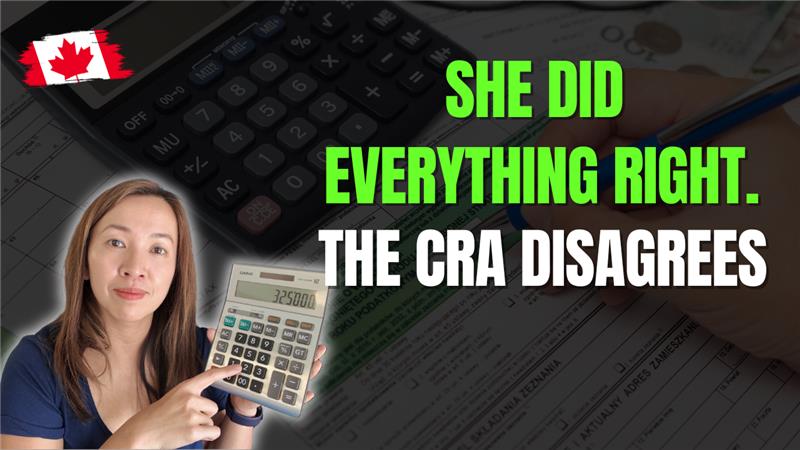
If both Sandra and David were to pass away today, the tax on their estate is $325,762.
By the time Sandra reaches age 70, that number climbs to $561,801.
By age 75, it peaks at $591,850.
That is not a rounding error. That is a real, growing liability sitting quietly in the background while Sandra focuses on saving and investing.
It keeps growing because her RRIF balance and rental property are both appreciating at the same time. The registered accounts get drawn down eventually. But the rental property capital gain just keeps building until the day she passes away and the CRA triggers it automatically.
This isn’t because Sandra did anything wrong. It’s because her registered accounts and rental property gains create a large taxable event on death that most people never see coming until it’s too late.
Sandra has no life insurance. No plan to fund this liability. And a will that hasn’t been updated since 2004.
What I’d recommend:
At minimum, Sandra and David need an updated will that reflects their actual financial situation today. Beneficiary designations on their RRSPs and TFSAs should be reviewed immediately.
Beyond that, a permanent life insurance policy can be structured to fund the estate tax bill so Sandra’s assets pass to her kids instead of the CRA. For someone in Sandra’s situation this is a conversation worth having seriously.
$325,762 is the number. Now Sandra knows it.
The Big Picture
Sandra came to me thinking she had a savings problem. She actually has a tax timing problem.
She has built real wealth. A growing RRSP. A rental property. A TFSA. A spouse with lower income. That is a genuinely strong financial position.
But without a plan, a significant portion of that wealth goes to the CRA instead of to Sandra, David, and eventually their kids. This is about managing tax, not escaping it.
Sandra has five years before she retires. That is enough time to make a real difference. But only if she starts now.
Are You in Sandra’s Shoes?
If this story sounds familiar, you are not alone. I work with Canadians like Sandra every week.
The question is not whether you have saved enough. The question is whether you have a plan to keep as much of it as possible.
Book a consultation with my team at realestatetaxtips.ca. We will look at your actual numbers and build a retirement income plan around your specific situation.
And if you found this helpful, subscribe to our YouTube channel and join our 19,000+ email subscribers for weekly Canadian tax strategies that actually apply to your life.
Next Steps
We help everyday Canadians navigate the confusing world of taxes—so you can keep more of what you earn. Want to make sure you’re not leaving money on the table? Book a consultation with my team today.
Until next time, happy Canadian Real Estate Investing.
Cherry Chan, CPA, CA
Your Real Estate Accountant